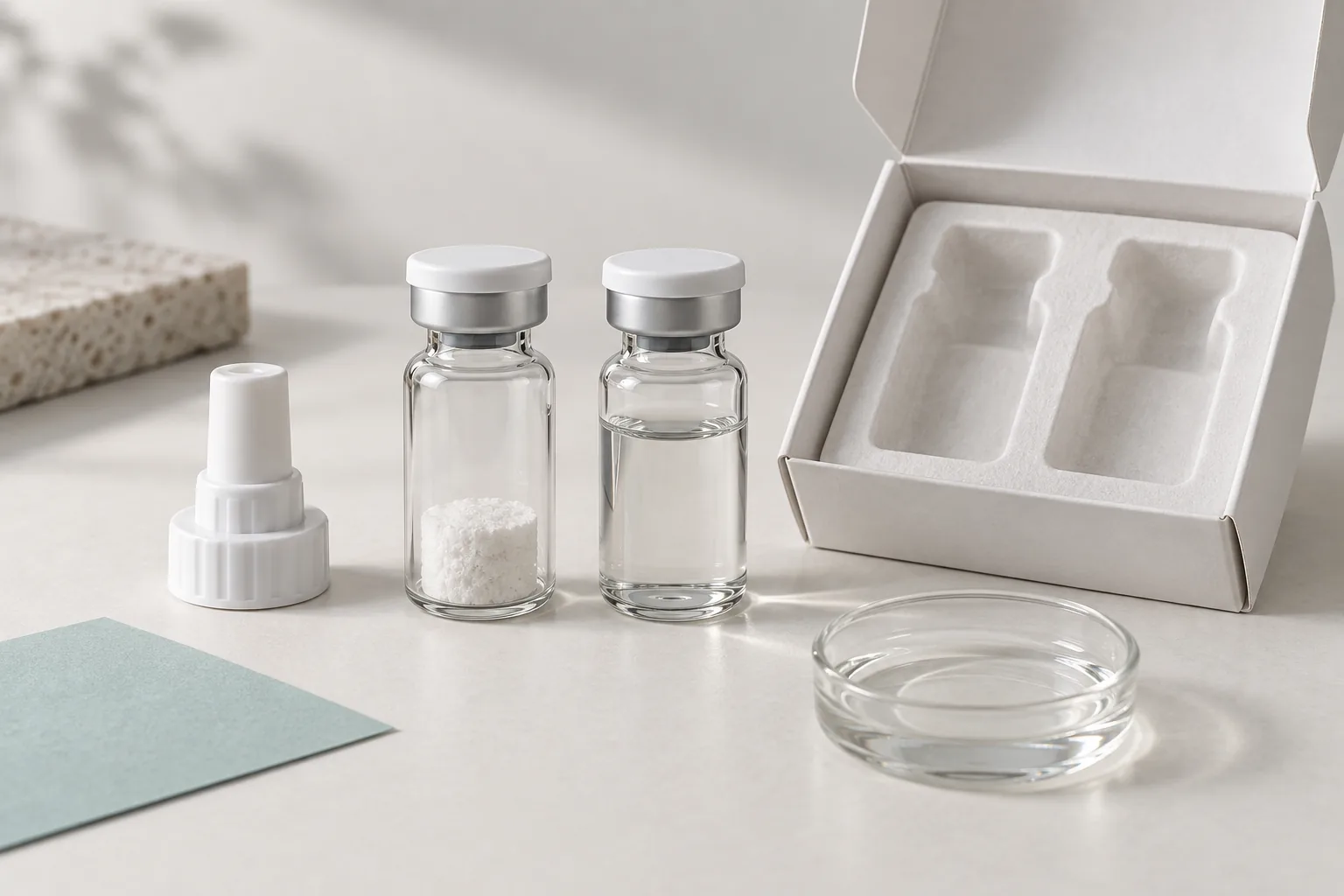
Start with the finished product in someone’s hands. Should they open it and apply it immediately, or add a liquid and mix it first? A dry format adds a preparation step. It needs a reason that matters to the product, and instructions the customer can follow.
What freeze-drying and BFS each do
What reaches the customer?
Freeze-dried skincare
- A dry product protected until use
- A specified liquid and mixing step
- Trials for drying, storage and preparation
BFS skincare
- A suitable liquid or semi-solid in a sealed unit
- An opening and dispensing step
- Trials for filling, storage and delivered amount
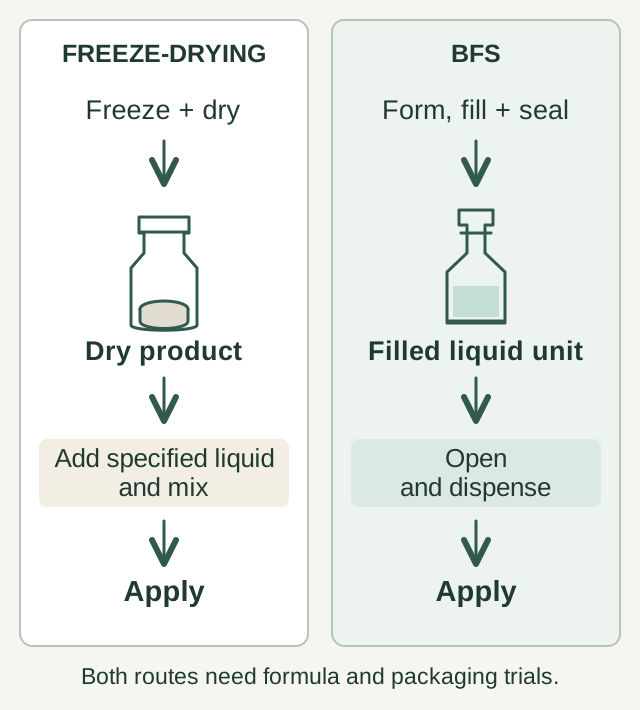
Freeze-drying, or lyophilization, removes water after freezing. Under reduced pressure, ice passes directly into vapour during primary drying; secondary drying removes additional moisture. GEA explains these stages in its pharmaceutical freeze-drying overview.
BFS makes and fills the container. Rommelag describes a cycle that forms a polymer container, fills it with liquid or a suitable semi-solid, and seals it. The contents remain in that form. To supply a dry product and a liquid together, you would need separate components.
Does keeping the formula dry solve a storage problem?
If a liquid formula changes during storage, begin with the change you can measure and the conditions in which it happens. Those observations give the development team something to investigate. Freeze-drying is worth testing when keeping the formulation dry could address that problem.
Test the whole formula through freezing, drying and preparation for use. An ingredient that tolerates freeze-drying does not tell you how the finished blend will behave. Decide what dry form you want, such as a cake or bead, and how it will be protected from moisture in storage and transport.
Then try the preparation step with the proposed pack. Which liquid does the customer add? How much? How do they mix it, and how long should it take to reach the intended texture? A dry sample that looks good in its container still has to become a usable product.
If the customer needs an open-and-apply product, this extra step may rule out the format. And if the formula already performs well as a liquid, identify what the dry version would improve. Longer shelf life or better skin results would each need their own supporting tests.
Can the liquid work in a BFS single-dose pack?
One extra step changes the customer’s routine
Simplified routes for a dry product mixed before use and a ready-to-apply BFS liquid. Formula suitability and pack performance must be tested.
A ready-to-apply serum or a separately packed mixing liquid can be a starting point for a BFS project. The first practical question is whether the formula can be filled and dispensed through the chosen container. Viscosity, particles and foaming belong in that discussion.
Try opening and emptying representative filled units. Can the intended user twist the top off, squeeze the pack and dispense the amount they need? Record what remains inside. A nominal fill volume tells you how much went in; a use trial tells you how much comes out.
The filling trial also needs to represent the temperature conditions the formula will encounter. Rommelag describes cooling options for temperature-sensitive products, but availability on the proposed line must be checked. Review the contact material and the pack’s protection against moisture, oxygen and light under the intended storage conditions.
If the pack cannot meet those requirements, compare glass ampoules or preformed containers. The formula and packaging compatibility guide sets out the questions to take into that review. A product that needs to stay dry will still need a separate dry-product process.
Could the dry product and BFS liquid come in one kit?
They could be separate parts of a development concept: a dry product in a protective container, paired with a mixing liquid in a BFS unit. Each part would need its own formula, process and packaging assessment, followed by a trial of the complete kit. This is a hypothetical arrangement, not a confirmed SteriDose product.
Follow the liquid all the way to the dry product. Some may remain in the BFS container or be lost during transfer. If the recipe needs a specified mixing amount, matching it to the printed fill volume is not enough. Check how much reaches the dry product and how much of the mixture is then available to apply.
Use the proposed containers and instructions for that trial. Check that the components are easy to identify and pair, and decide what the user should do with any remainder. Storage conditions for the unopened kit do not establish how long the mixed product can be kept. The freeze-dried serum development guide goes further into the dry formula, companion liquid and kit specification.
What must the samples prove before you choose?
Give each trial a decision to support. For freeze-drying, that could mean the agreed dry form, residual moisture, mixing behaviour and stability in the protective pack. For BFS, it could mean consistent filling, an intact container, usable dispensing and stability in that container. Define the formula, process and packaging versions so the results can be traced to the product you will order.
Both routes also need microbiological requirements and safety and claim support appropriate to the intended use and market. Agree who reviews the records and which changes would require more work. Neither “freeze-dried” nor “BFS” establishes sterility or removes the need for a preservation strategy.
The process references explain technology, not the suitability of your cosmetic or the equipment available for your project. For example, FDA’s 1993 pharmaceutical lyophilization guide treats cycle validation, equipment sterilization and product testing separately. It is a historical pharmaceutical reference, not a cosmetic approval standard.
Price the complete product the customer will use
A dry-and-liquid kit can involve formula work, drying-cycle development, protective containers, liquid manufacture and filling, testing and assembly. A BFS product needs formula and process assessment, any container or mould work, filling, testing and retail packing. Ask for development charges separately from recurring supply costs, then compare the cost of complete usable applications.
Existing tooling, formula readiness, available test results, quantity and component count all affect price and timing. Ask the supplier which unresolved step is holding up a firm quote. That answer is more useful for planning than a general claim that one technology is cheaper or faster.
Bring these five answers to the first technical discussion
- What happens to the product now, and what do you need to improve?
- Where will the customer use it, and can they mix it before applying?
- Which formula, sample and test records can you share?
- What pack, storage conditions and opening steps must a trial represent?
- What result would make you stop work on this route?
Take a storage problem and a proposed mixing routine into a cosmetic lyophilization review. Take a suitable liquid and the intended dose and opening method into a BFS contract manufacturing review. Keep conventional packaging in the comparison wherever it already meets the brief.