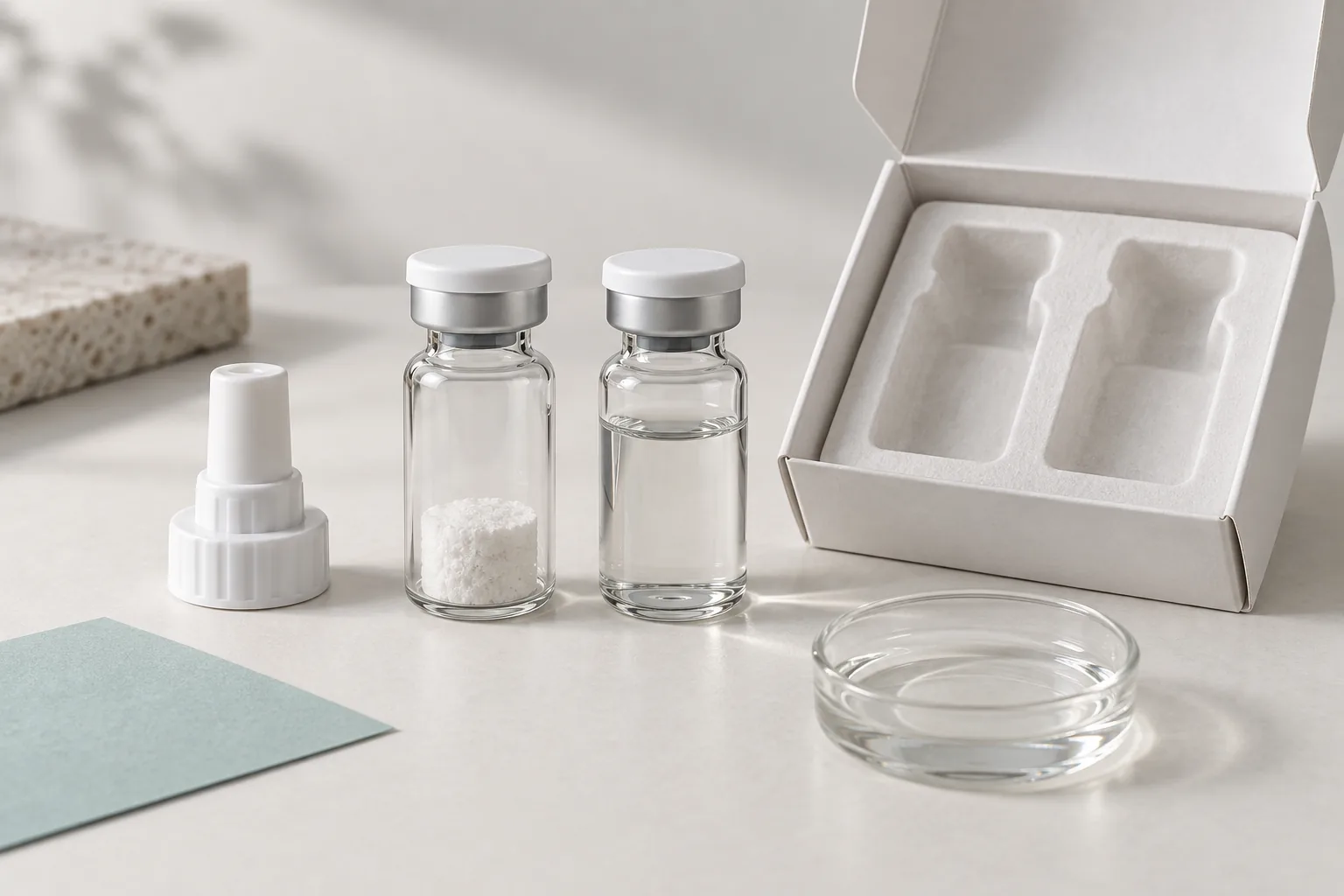
SteriDose coordinates freeze-dried serum development and packaging through partner factories. Their catalogues show dry-powder and companion-liquid formats, including paired vials and combined-pack concepts. The finished offer covers the dry component, the liquid, the opening and dispensing method, and the retail pack agreed for the project.
What is a freeze-dried serum?
Freeze drying, also called lyophilization, removes water from a frozen formulation under reduced pressure. In the primary drying stage, ice changes directly into vapour. Labconco’s freeze-drying FAQ explains the process. In a two-component skincare product, the dry material is later combined with a specified liquid to prepare the serum for application.
The term describes a manufacturing process. It does not establish the finished product’s shelf life, preservative requirements or suitability for a particular skin concern. Those conclusions need evidence for the actual formulation and pack.
Develop the dry formula and activator as a pair
Begin with the serum after mixing: the amount available for application, the texture, the colour and how it should feel on skin. Then work back to the dry component and its companion liquid. Treating the activator as “just water” leaves part of the formula undefined.
The liquid composition, amount added and mixing method all belong in the sample specification. Changing the activator can change the prepared product even if the dry material stays the same. A customer should receive a clear instruction, rather than have to estimate the amount to add.
Record dry mass, activator volume and intended prepared quantity separately. A figure in grams on the powder vial cannot be substituted for a volume in millilitres. Include any residue left in the container when evaluating how much prepared serum can be dispensed.
Choose how the customer will mix and apply it
Three parts of the product to specify
- Dry formulaComposition, dry mass and container
- Companion liquidComposition, volume and mixing method
- Finished kitOpening, dispensing, instructions and pack count
A paired-vial kit keeps the dry material and liquid in separate containers. A combined pack aims to bring both parts into one product system. Either way, the development team needs to know how the user opens it, combines the contents and dispenses the serum onto the skin.
Plan the closure and dispensing accessory with the container. Avoid leaving those decisions until the carton design is finished. These are topical cosmetic formats; a vial-shaped container does not make a product suitable for injection.
If the product is a dry sheet or mask, use the freeze-dried facial mask guide for that format. Its handling and activation experience differs from preparing a serum in a vial.
Assess the sample before and after mixing
The dry appearance is only one part of the sample. Try the complete opening, mixing and application sequence using the proposed pack and draft instructions. Write down the observations that would lead to a change.
- Before opening: dry-product appearance, container condition, closure and identification of the two components.
- During preparation: ease of opening, transfer of the liquid, mixing effort, preparation time and material left undissolved.
- After mixing: colour, odour, texture, visible particles and dispensing through the chosen accessory.
- In the retail kit: fit of the insert, protection of the components, legible instructions and the number of complete pairs.
Agree the test programme and acceptance criteria with the manufacturing team. Depending on the formulation and intended use, this can include residual moisture, microbiological quality, container integrity and stability work. Appearance alone cannot establish those properties. The cosmetic lyophilization page sets out the manufacturing route.
Set the storage and use instructions for the finished product
The dry product and the prepared serum need their own storage and use assessment. Do not carry a shelf-life claim from the unopened kit over to the product after mixing. The instructions must state whether the prepared contents are for one application and how any remaining product should be handled.
Choose the protective packaging for the conditions the product will encounter during storage and transport. Moisture protection, light exposure and physical damage are questions for the actual container system. A white cake in a clear vial is a visual reference, not a stability result.
Quote the complete kit
For a powder-and-liquid set, state the number of complete pairs per retail box. Counting only the powder vials can leave the companion liquid, closures, dispensing parts or kit assembly out of the quotation.
Ask for the scope to identify formula development, the drying work, liquid preparation and filling, packaging components, agreed testing, artwork and packing. MOQ, sample fees and production timing depend on that scope. There is no single public figure that applies to all formats shown in the catalogues.
What to send for a freeze-dried serum project
Send the product idea or existing formula, the intended skin feel after mixing, your preferred container and any activator already specified. Add the destination market, expected number of retail sets, pairs per set and target launch date. A photo of the opening or application experience you want is useful even when the artwork is still undecided.
If you are still deciding between a liquid serum and a dry format, the facial serum OEM/ODM guide covers the wider packaging choice. For a powder-and-liquid project, send us both parts of the brief.