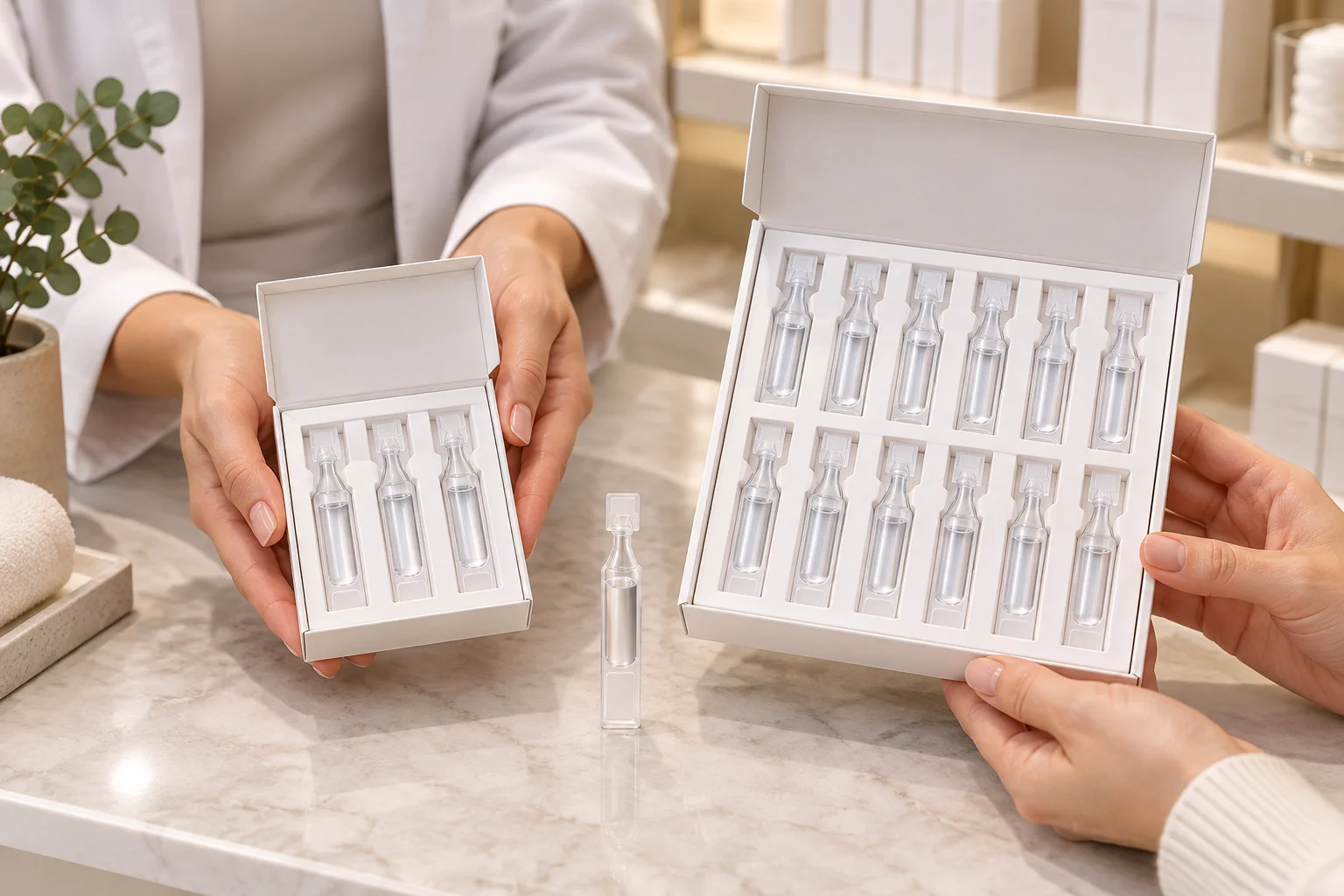
Professional skincare retail has changed. In many clinics and medspas, growth no longer depends only on treatment-room volume. It also depends on what happens after the appointment, especially whether patients continue with the right homecare products in a way that feels easy to understand, easy to follow, and easy to reorder.
That is where packaging format starts to matter almost as much as formula quality. For many clinic-retail programs, single-dose formats create a stronger operational and commercial fit than traditional multi-use packaging.
This does not mean single-dose is always the right answer. But in professional skincare retail, where recommendation quality, hygiene logic, protocol clarity, and usage compliance all matter, it is often a format worth evaluating seriously.
For brands building clinic-retail lines, the key question is not whether single-dose looks more premium. The more useful question is whether it improves the handoff from professional recommendation to real at-home use.
Why packaging format matters in professional skincare retail
Starter, reorder, multi-use
Format roles inside a clinic-retail programme. Availability and price stay project questions.
Starter kit
- Short protocol, counted units
- Staff can walk through opening once
- Useful when the first homecare week has to be obvious
Reorder pack
- Same unit as the starter, larger count
- Keeps the routine on one opening method
- Avoids teaching a second pack mid-programme
Multi-use bottle
- Familiar on a retail shelf
- Dose and hygiene need a different explanation
- Still the right answer when the brief is daily and recappable
A clinic-retail program is not the same as general e-commerce skincare. In a clinic or medspa setting, recommendation often happens in a high-trust moment. The patient may be post-procedure, skin-reactive, or following a suggested recovery routine. The product has to be easy for staff to explain, easy for the user to follow, and difficult to misuse.
That changes the role of packaging. Instead of functioning only as a container, the format becomes part of the retail system. It can either support compliance and clarity, or create friction after the patient leaves the clinic.
Single-dose formats tend to perform well in this environment because they make instructions more visible, routines easier to package, and homecare behavior more consistent.
In other words, format affects more than presentation. It affects whether the patient actually uses the product correctly, whether staff can explain the program quickly, and whether the retail offer feels structured enough to justify premium positioning.
Where single-dose formats create practical advantages
1. Better dose clarity for first-time users
Many clinic-retail failures are not caused by weak formulas. They happen because patients are unsure how much to use, how often to apply, or how to fit the product into a routine. Single-dose units reduce this ambiguity. One unit signals one use occasion, which simplifies explanation and supports more consistent first use.
2. Cleaner handling and stronger hygiene logic
In professional skincare retail, hygiene is part of the product story. Repeatedly opening a multi-use container can create more handling variability over time. Single-dose formats reduce repeated exposure and support a cleaner, more controlled usage narrative, especially for sensitive-skin or post-procedure positioning.
3. Stronger protocol packaging for clinic programs
Many clinic-retail products are not sold as isolated SKUs. They are sold as part of a regimen, such as a 3-day calming pack, a 7-day recovery sequence, or a starter routine for homecare continuation. Single-dose units fit naturally into these structures and make protocol design easier to communicate.
4. Better sampling and trial conversion
Sampling in professional channels works best when the first-use experience is controlled. Single-dose samples help deliver a more consistent trial experience, cleaner presentation, and easier product framing. That can improve conversion from treatment-room recommendation to paid retail purchase.
5. Clearer premium retail architecture
Single-dose formats can also support premium positioning. They make it easier to build structured kits, trial boxes, and protocol-led programs with clearer pricing logic. While unit economics must be assessed carefully, many brands benefit from stronger perceived precision and better regimen packaging.
Comparison table: program goals and packaging fit
| Program goal | Typical retail challenge | Why single-dose can help | Watch-out point | |---|---|---|---| | Post-procedure starter kit | Patients forget or misapply instructions | Fixed per-use dose supports compliance and confidence | Keep protocol simple and easy to finish | | Sensitive-skin clinic retail line | Hygiene and tolerance concerns | Cleaner handling story and reduced repeated exposure | Align claims with formula and evidence | | Treatment add-on upsell | Weak continuity from treatment room to homecare | Protocol packs improve handoff quality | Train staff on short recommendation scripts | | Sampling for new product launch | Inconsistent first-use experience | Controlled sample format improves trial quality | Build a clear path to reorder | | Premium seasonal retail program | Margin pressure and SKU complexity | Structured kit logic can justify premium positioning | Validate COGS and refill assumptions early |
A practical workflow for clinic-retail teams
A strong professional skincare retail program usually follows this sequence:
- Define the scenario first : treatment type, skin condition, and homecare window.
- Set the protocol logic : usage timing, duration, and any stop or adjust rules.
- Match unit format to protocol : decide how many units are needed per day or per cycle.
- Pilot with small cohorts : track adherence, refill interest, and staff usability feedback.
- Scale with a clear kit structure : keep the dosage logic and patient instructions consistent.
This order matters. A common mistake is choosing packaging too late, after formula, claims, and retail framing have already been fixed.
When single-dose is not the best choice
Single-dose is a strong fit for many professional-retail scenarios, but not all.
It may be less suitable when:
- the product is meant to be used in highly variable amounts,
- the line is competing mainly on low-price mass retail logic,
- the program has no protocol or guidance layer,
- the brand cannot support clear staff and patient education,
- the packaging cost would distort the commercial model.
The right goal is not to follow a format trend. The goal is to choose a format that improves the retail system around the product.
How to evaluate fit before launch
Before committing to development, teams should usually test five points:
- Scenario fit : Does the product genuinely benefit from controlled dosing?
- Channel fit : Will clinic staff be recommending and explaining it directly?
- Cost-value fit : Does the program outcome justify the packaging structure?
- Supply fit : Can the OEM path support pilot, iteration, and scale-up cadence?
- Conversion fit : Is there a clear bridge from in-clinic recommendation to reorder?
If most of these answers are yes, single-dose is often a strong candidate for professional skincare retail.
Conclusion
Professional skincare retail programs succeed when recommendation quality survives the handoff to homecare. Single-dose formats can strengthen that handoff through clearer usage, cleaner handling, and stronger protocol packaging.
For clinic and medspa brands, the most useful question is not whether single-dose is universally better. The better question is whether it improves compliance, clarity, and continuity for the specific retail scenario you are trying to build.
If the answer is yes, single-dose packaging can become more than a packaging choice. It can become part of the retail model itself.
FAQ
Why do professional skincare retail programs often fit single-dose packaging?
Because clinic-retail programs usually depend on clearer usage instructions, stronger hygiene logic, better sampling quality, and easier protocol design. Single-dose formats support all four.
Is single-dose only useful for post-procedure products?
No. Post-procedure is one strong use case, but single-dose can also fit sensitive-skin retail lines, starter kits, treatment companion products, and clinic-led sampling programs.
Does single-dose packaging always improve retail conversion?
Not automatically. It helps most when the retail program already has a clear recommendation flow, a defined homecare scenario, and a simple reorder path.