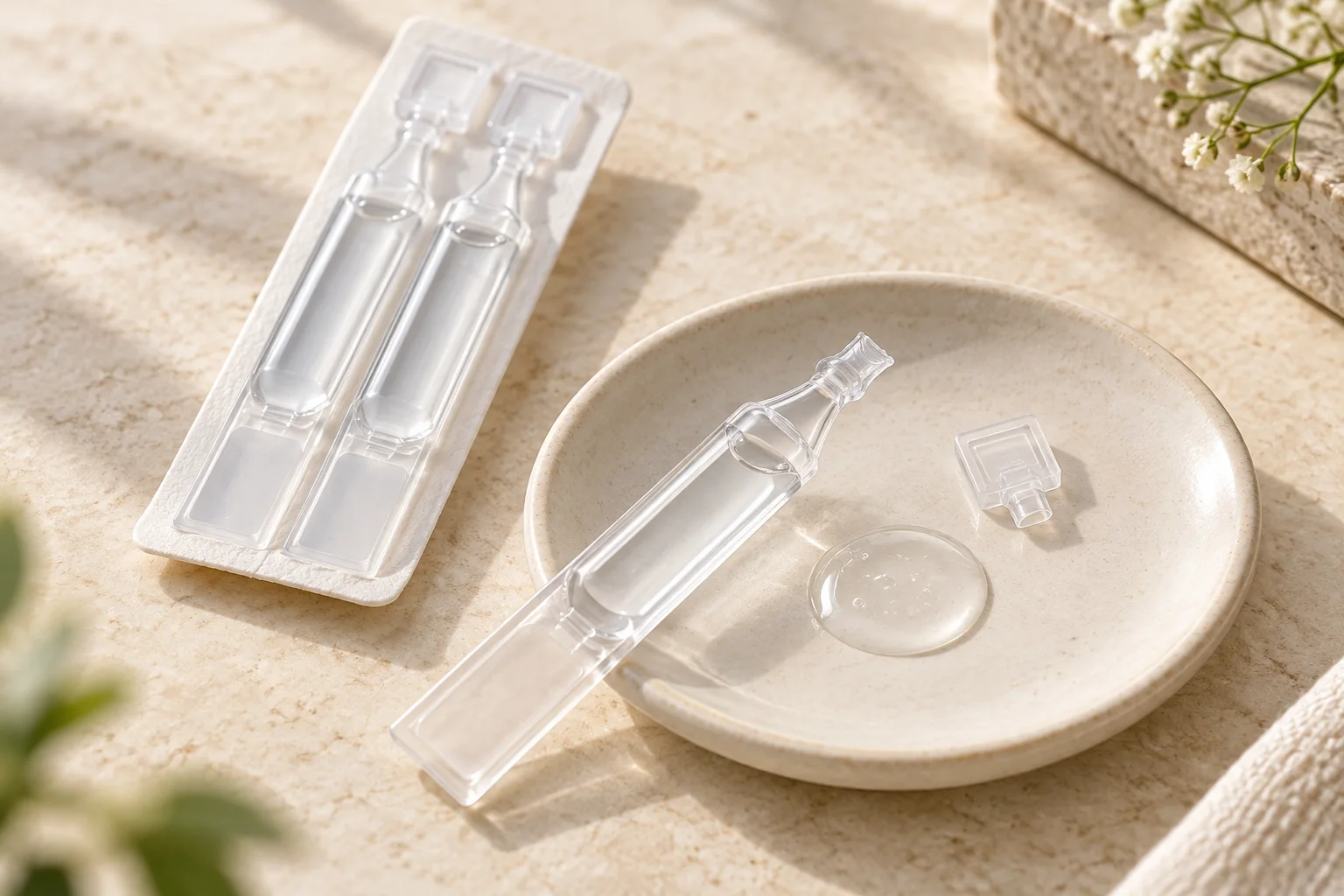
Do sterile single-use vial cosmetics need preservatives? Not necessarily. A preservative-free formulation still needs a demonstrated protection strategy for the actual formula, manufacturing process, sealed pack and intended use. A single-dose container alone is not evidence that preservatives can be omitted.
Single-dose describes a container intended for one use occasion. Sterile describes a condition that must be supported by evidence for the product and process; it is not another name for a small sealed vial or a clean filling room.
The idea is simple: instead of asking one bottle, jar, or dropper to stay stable through repeated opening and handling, the brand gives the user one sealed dose at a time.
This format is most relevant for skincare concepts where hygiene, dose consistency, formula protection, and sensitive-use positioning matter more than ordinary multi-use packaging convenience.
For brand teams, sterile single-dose skincare is not only a packaging choice. It affects formulation strategy, filling method, stability testing, claim language, secondary packaging, MOQ planning, and how the product is explained to buyers or end users.
What does sterile single-dose skincare mean?
Single-dose unit versus a multi-use reservoir
Exposure control is a pack mechanism. Preservative need is still decided per formula, fill path and claim.
Sealed single-dose
- One use occasion per container
- Bulk stays closed until that unit is opened
- Does not by itself mean preservative-free
Multi-use jar or pump
- One reservoir across many openings
- Repeated air, hands and bathroom storage are part of the life cycle
- Preservation is usually built for that model
Keep three separate questions in the product brief:
- Use format: how much one sealed unit contains and how it is used after opening.
- Manufacturing evidence: how the required microbiological condition is established and maintained for that product.
- Formula protection: how composition, preservation, container integrity and storage conditions work together.
The exact manufacturing setup depends on the product, packaging, and quality requirements. Some programs may use blow-fill-seal logic, aseptic filling discipline, or other controlled filling approaches. The common goal is to reduce avoidable exposure points and create a more disciplined delivery format.
Do sterile single-use vial cosmetics need preservatives?
Not always, but the answer depends on the whole product system.
The FDA explains that cosmetic contamination can arise from ingredients, manufacturing conditions, ineffective preservation, inadequate packaging, storage or consumer handling. These are different potential sources, so changing only the container cannot settle every microbiological question.
A one-use vial avoids repeated opening of the same container when used as intended. That changes the handling scenario, but it does not by itself determine the preservation system or establish safety after opening.
That is why many brands evaluate single-dose formats when they want to develop preservative-reduced or preservative-free skincare concepts.
However, single-use packaging does not automatically make a product safe without preservatives. The final decision depends on:
- formula composition and water activity
- filling and sealing controls
- package integrity
- raw material bioburden control
- shelf-life and storage conditions
- target market requirements
- microbiological and stability testing results
In other words, sterile single-dose packaging can support preservative-free logic, but it does not replace formulation, testing, or compliance review.
For OEM buyers, this is where single-dose becomes a sourcing question rather than only a technical answer: the manufacturer should review formula readiness, fill volume, package integrity, pilot testing, and market documentation before making preservative-related claims.
If you are comparing suppliers, ask how the filling route, one-use package, and stability plan work together for topical skincare -- not parenteral, injectable, or drug applications.
Why brands use sterile single-dose formats
Brand teams usually evaluate sterile single-dose skincare when they want to solve several practical problems at the same time.
Cleaner handling logic
Each unit is opened once. That helps reduce repeated-open handling and makes the product story easier to explain for hygiene-sensitive categories.
More consistent dosing
A one-use unit helps standardize how much product is applied. This is useful for post-procedure routines, protocol packs, starter kits, and treatment-style skincare systems.
Better fit for sensitive positioning
For sensitive-skin, post-procedure, or preservative-conscious products, the format can make the overall product architecture feel more controlled and intentional.
Stronger premium presentation
Single-dose packaging often communicates precision, freshness, and professional care. That can support medspa, clinic, or high-value retail positioning when the economics make sense.
Where sterile single-dose skincare is a strong fit
The format is usually most relevant for:
- post-procedure recovery products
- medspa take-home recovery kits
- sensitive-skin or barrier-support serums
- preservative-conscious or preservative-free concepts
- active-heavy formulas where repeated exposure is a concern
- premium starter kits and protocol packs
Where it may not be the right fit
Sterile single-dose skincare is not automatically better for every product. It may be a poor fit for large-volume daily cleansers, low-margin commodity moisturizers, body products requiring large application amounts, products where low packaging cost is the main priority, or formulas requiring highly flexible consumer dosing. The format should be chosen because it supports the formula, use case, and business model, not because it sounds more technical.
What brand teams should evaluate early
Before choosing a sterile single-dose route, brand teams should review: formula suitability for the intended filling method, target fill volume practicality, preservative-reduced positioning feasibility, target market documentation requirements, pilot-run economics and MOQ fit, and packaging story clarity for buyers and end users.
This is why manufacturing partner fit matters. A useful partner should be able to discuss formulation, filling, packaging, testing, and commercial scale-up as one connected decision path.
What evidence should a brand request?
Ask the formulation and manufacturing team to identify what is already supported and what still needs work for the exact formula and pack:
- The formula version and proposed preservation strategy.
- The relevant microbiological assessment and the scope of any challenge or other agreed tests.
- How the sealed container and storage conditions are assessed for the proposed shelf life.
- The opening, single-use and disposal instructions used in the assessment.
- Which records support a proposed sterility or preservative-free claim, rather than the appearance of the pack.
Agree methods and acceptance criteria with the responsible specialists; this is a request checklist, not a universal test protocol. The formula and packaging compatibility guide covers the next questions for a candidate container. Cosmetic packaging is not evidence that a product is suitable for injection or use on compromised skin.
How SteriDose Labs fits this category
SteriDose Labs works with skincare brands evaluating sterile, preservative-conscious, and single-dose development pathways for higher-control product concepts.
If your team is evaluating whether a sterile single-dose format is suitable for a preservative-conscious, post-procedure, sensitive-skin, or medspa skincare project, the next step is to review our single-dose manufacturing services or submit your project brief for a formulation-to-packaging fit review.
FAQ
Do sterile single-use vial cosmetics need preservatives?
Not always. A sterile single-use vial can reduce repeated-open exposure and may support preservative-reduced or preservative-free concepts. But the final decision depends on the formula, package integrity, filling process, shelf-life target, market requirements, and safety testing.
Is single-dose packaging the same as sterile manufacturing?
No. Single-dose is a use format; aseptic processing is a manufacturing approach; sterility is a product condition requiring supporting evidence. Keep these terms separate when reviewing a formula and its container.
Can an existing formula be moved into a single-dose vial?
Sometimes, but it should be reviewed first. The formula may need compatibility, viscosity, stability, and packaging-fit checks before it can be confirmed for single-dose production. Contact our team to discuss formula transfer feasibility.