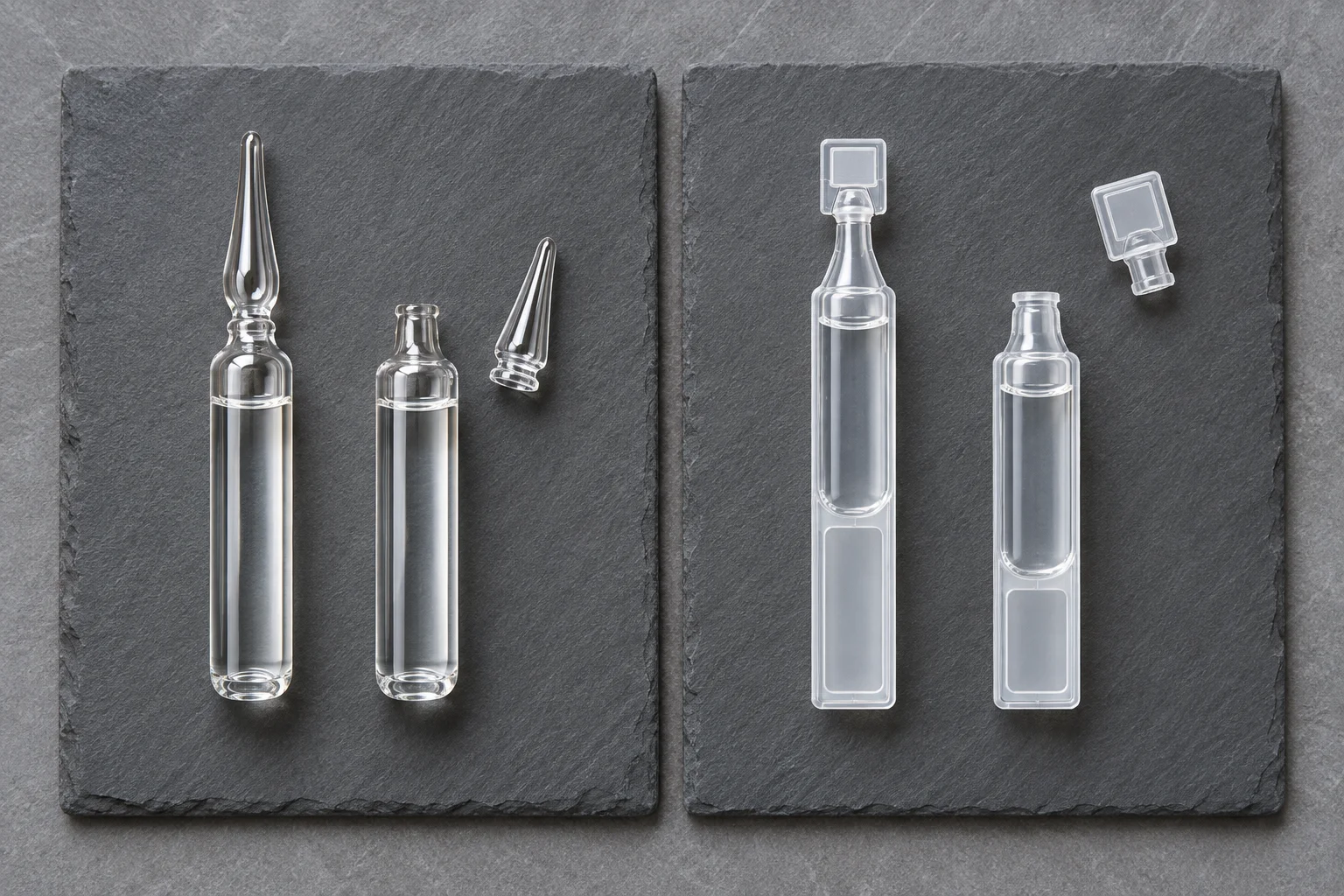
Choose between a BFS polymer unit and a traditional glass ampoule by scoring the same brief on formula and barrier need, closure and opening, use setting, and logistics. Appearance and category habit are secondary. The better route is the one that fits those four.
This page is a route decision for topical skincare and cosmetic single-dose packs. It does not rank one material as premium, and it does not publish capacity, yield, or cycle time.
Comparison dimensions
Comparison dimensions
Scorecards and premium badges stay off the page. Barrier, chemistry fit and market expectation still decide.
BFS polymer unit
- Container is formed, filled and sealed in one sequence
- Opening is designed into the mold
- Lighter handling in shipping and salon use
- Often read as travel-safe and simple to open
Traditional glass ampoule
- Preformed glass, filled and flame-sealed
- Scored or one-point-cut break-open neck
- Heavier; fragments need handling controls
- Often read as heritage or clinic-coded
Put both routes on the same brief: formula, dose, opening, handling during shipping and use, and how the unit is packed for the channel.
In blow-fill-seal, the polymer container is formed, filled and sealed in the same cycle. A traditional glass ampoule is preformed, filled, and flame-sealed. Equipment descriptions of aseptic filling machines use that contrast with preformed containers. Those are general process descriptions. They are not evidence of a named SteriDose line.
Read the two manufacturing pages together: BFS and glass ampoule filling.
Formula and barrier
Barrier need, chemistry fit, and light or oxygen sensitivity belong with the formula, not with a preference for glass shine or polymer softness. If the formula still requires a glass contact surface, or a barrier the polymer option has not been reviewed for, glass stays in the conversation. If the formula is already being developed for a polymer single-dose unit, BFS is a route to evaluate for that pack.
Neither sentence selects the route by itself. Ask which contact materials are allowed, which are still untested, and which studies will be run only after the route is chosen. Keep a candidate pack provisional until the agreed compatibility work supports its use.
Closure and opening
Glass ampoules are typically scored or one-point-cut and break-opened. Polymer BFS units usually twist or tear on an opening designed into the mold. That difference changes instruction copy, salon training, and whether fragments have to be managed.
Match the opening to the user. A treatment-chair concentrate that is snapped and applied by a professional is a different closure problem from a home kit that must be opened without snapping glass. Fill volume can be similar in both cases.
Use setting
Where the unit is opened matters as much as how. Clinic, salon, bathroom cabinet, and travel pouch each tolerate a different handling risk. Glass packs are often heavier and can shatter; polymer packs have different weight and damage characteristics. Those are handling facts for the use setting.
If the SKU is sold as a professional ampoule, ask whether staff expect a break-open ritual. If it is sold as a take-home or travel unit, ask whether the user will carry it, squeeze it, and discard it without a tray of glass.
Logistics and pack-out
Weight, breakage, secondary pack, and channel constraints belong in the same decision as the primary unit. A polymer strip or tray pack is a different shipper problem from individual glass ampoules that need cushioning and breakage protection in transit.
Format families for polymer units are listed under BFS packaging formats. Ask whether the channel needs a strip, a tray, individual cartons, or a kit, and whether additional breakage protection is needed in that pack-out. Those answers often split a brief that looked identical at fill volume. Quantity, mold status, and pack-out still change the production conversation on both routes. Those figures stay in project review.
Hypothetical route decision
Score a live brief against this list before anyone argues from category habit:
- Has the formula been reviewed for glass contact, polymer contact, or both?
- Is the opening break-open, twist-off, or still undecided?
- Who opens the unit, and where?
- What shipping and salon-handling constraints are already known?
- Which secondary pack is required by the channel?
Imagine two briefs with the same 1 ml fill. Brief A is a clinic-coded concentrate, break-opened at a treatment chair, stored in a supervised cabinet. Brief B is a travel kit, opened by twisting off a tab, packed in a lightweight carton for mixed shipping. Brief A may still point at glass. Brief B may point at a polymer BFS unit. The fill volume did not decide it. Formula review, opening, use, and logistics did. Both briefs are hypothetical. They do not report a conversion rate or a damage result.
If the live question is why some brands move away from glass as a category habit, that discussion sits on replacing glass ampoules. This page stays on the four-dimension decision for one SKU.
Compare both routes on the brief you have
Bring formula status, preferred opening, use setting, and logistics constraints. Review both technology pages, then open a project review if the brief is still split.